自己リトリート19【勝浦が涼しい理由を求めて】
いやぁ、忙しい!!
セミの大合唱、むせ返るような熱気!まさに夏真っ盛り。亀リト豊島は、連日虫捕りに魚捕り、カブトムシ捕りに大忙しです。
疲れも出てきていますが、定期的に自分のリトリートを行いながら、上手に過ごしています。
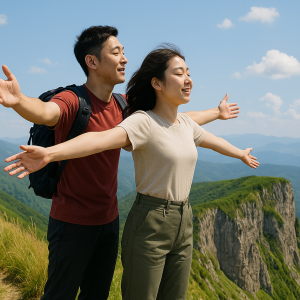
さて、昨日の「山でタイタニック」のブログですが、私は日常的にそのような感覚を持って暮らしています。
きっと「ブラタモリ」が好きな人は、似た感覚を持っていると思うのですが、地形や自然現象、歴史などに興味を持っている人は、世の中のいろんな事を、自分自身で楽しみながら味わって生きています。
私が尊敬する人の1人、タモリさんは、いろんなことを観察したり、感じたり、考えたりしながら、感触として「生きる」を味わうことを極めた人なんだと思います。
それはともかく、久しぶりの休日、勝浦がなぜ涼しいのかを、自分自身の探求心で見てこようと思い立ちました!!
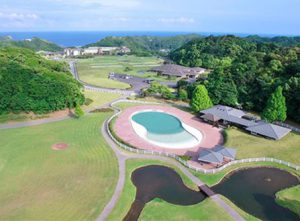
実はワタクシ、勝浦で7年間 (2001年~2008年)海洋療法のセラピストとして働いていました(テルムマラン・パシフィーク、現在は閉業)
最近になって「勝浦が涼しい」と話題になりはじめたのですが「7年いたけど結構、暑かったぞ!」と思うのが、私の正直な感想で(笑)それを自分の足で確かめる事にしました。
自分の探求心を全開にする、これもリトリートの一環です。
ちゃんと専門家の方から、データに基づいて理路整然と理由は出ている事ではあるのですが(公式見解だから、こちらの方が正しく、私の方が私論です)
ただ、私たち現代人の悪い癖で「専門家がこう言っているから」「客観的データで科学的根拠が出ているから」と言われると、そこで思考停止になってしまい、疑問すら感じず、自分で調べたり、考えなくなってしまう傾向があると思います。
「そもそも、何でそんなデータが出ているんだろう?」
私は、このように素直に思います。実際、暑いと思っていたし、そんな気持ちに蓋をせず、疑問に思った事を自分の探求心で調べるというのは、とても大切な習慣だと思います。
今の時代、スマホさえあればパッと何でも調べる事ができます。
しかし、思考停止して、自分で感じたり確かめることをやめてしまったら、学者さんやGoogle先生、そしてAIの言いなりの人生になってしまいます。
前置きはさておき、勝浦に向けてGO!!
大多喜を抜けて、国道297号線を南に向かって進みます、カーラジオは米軍FM、アメリカのヒットソングを聴きながら、DJの軽快なトークは英語のヒアリングを鍛える最高のトレーニング、気分爽快なドライブがスタート!!
すると「山の上のケーキ屋さん」と書いてある看板を発見!!
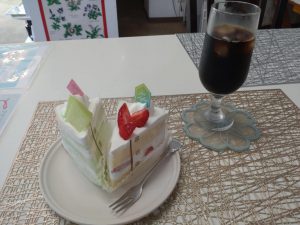
まあまあ、休日ですから(笑)(笑)イチゴショートとメロンショートのどっちにしようか悩みに悩んで、結局「両方」をチョイスするいけないわたし、リトリートの達人は自分の気持ちに正直です(笑)
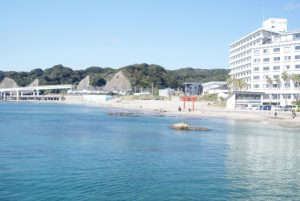
さぁ!道中で誘惑もありましたが、無事に(誘惑に負けて)勝浦に到着しました!!海が青い!!
でも、目的地は勝浦の海ではなく、勝浦特別地域気象観測所(アメダス)です。勝浦市の気温は、このアメダスで観測しています、よく天気予報でアメダスって聞きますよね、気温や風力などの観測所のことです。
私には、一つの仮説がありました。
それは、勝浦のアメダスの場所が、そもそも「海沿い」または「山でタイタニック」のような、海風が抜ける場所にあるんじゃないかな?ということです。
海風が当たりやすく、涼しい気温のデータが取れる場所にアメダスがあるだけかも知れない。
勝浦時代の私はサーフィンをやっていて、九十九里から館山まで波のコンディション次第で様々なエリアに行きましたが、実際、勝浦に限らず外房ならどこでも「海風さえ入れば涼しい」それが、現場で感じていたリアルな実感です。
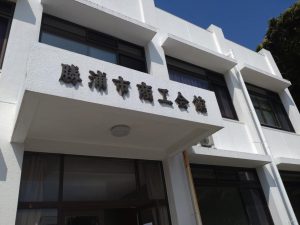
さて、Googleナビに「勝浦特別地域気象観測所」と入れて向かったら、何か酒屋さんの倉庫に案内されてしまいました、あれ?何かおかしいぞ。。
と、言う訳で聞き込み調査です、商工会なら何か分かるかなと思って近くにあった商工会に突撃します。
職員さん「アメダス。。。この辺にそんなところあったかな。。?」と言った感じで、職員さんも知らない様子です。
私が「最近、勝浦が涼しいと話題になっているので、調べに来たんです」と言うと、
女性職員さんが「勝浦、涼しいですか?」と笑っていました。
私は「めっちゃ暑いです!!」と即答(笑)商工会の場所は海風も当たらず、とっても暑かったです。
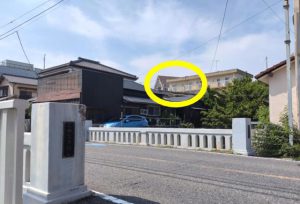
ここからは徒歩で散策、汗だくになって住所の場所を探しました。
すると、、ありました!!アメダスです!!観測機器がおいてあるので分かりました。墨名川(とながわ)という小さな川の川沿いにあります!!
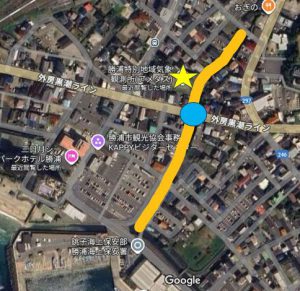
私がいる場所は青丸部分、星マークがアメダスの場所、墨名川はこのように流れています。
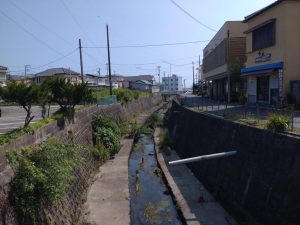
墨名川は細い細い、小さな川ですが両サイドが護岸工事で固められています。
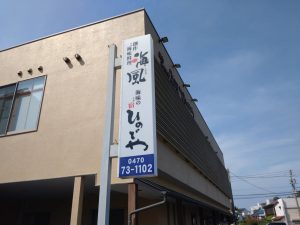
川沿いにある創作海鮮料理のお店の名前は「海風」になっていました。
もしかしたら、この墨名川が海風の通り道になっているんじゃないか?まず、ひとつの仮説が頭をよぎります。
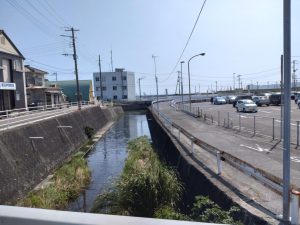
墨名川を下流に向けて進んで行くと、海まで続いています。
汗が首筋をつたう。Tシャツが背中に張り付くほどの暑さでしたが、海風が頬をなでると一気にクールダウン。やっぱり海風が吹けば勝浦は涼しい!!
まんざら、この仮説は間違っていないような気がしてきました。
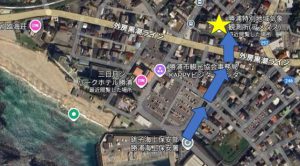
【仮説1】ここで仮説1が出来ました、海風が墨名川をさかのぼってくる「谷風」説です。
谷風とは渓谷で吹く風ですが、このような小さな川でも両サイドが護岸工事によって渓谷のようになっていたら、遮るものがなく海風が通り抜けてくるように思います。
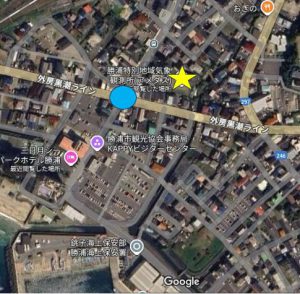
さて、仮説1で間違いない!と思い込みが起こってしまっても良くないので、他の可能性も探してみましょう。
隣の勝浦駅前交差点に移動しました、青丸が私がいる場所です。
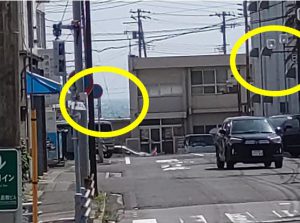
隣の通りに来てみました、南(海の方角)を見ると、左側の黄色い丸には海が見えて、海から近い事が分かります。
そして、右の黄色い丸は有名な「ホテル三日月さん」です。
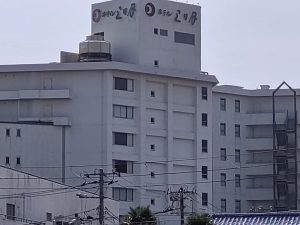
三日月さんは、こんな感じでとても大きい施設です。
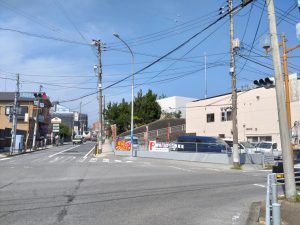
反対(北方向、アメダスの方向)を向くと、勝浦駅前交差点があります。肌に当たる風の感覚としては、墨名川沿いよりも、こちらの方が風を強く感じます。
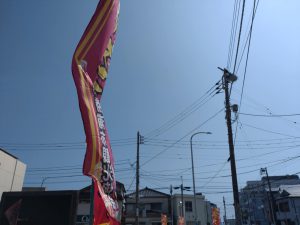
アメダスの前には、勝浦タンタン麺のお店があり、のぼりがバサバサと風でなびいています、しかも海風でとても涼しく感じます。
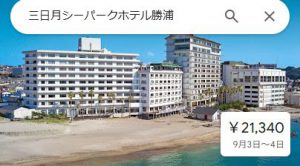
ホテル三日月さんは、このように海に向けて帆を立てたような風を受ける構造をしています。
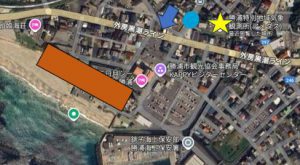
私は、少し北側に移動してアメダスの真横まで来ました。北側から南方向(青矢印の方向)を見ます。
四角がホテル三日月さんです。
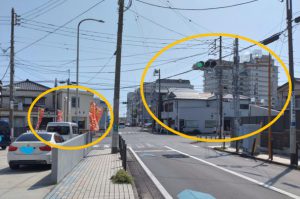
右の黄色い丸がホテル三日月さん。そして、左の黄色い丸では勝浦タンタン麺のお店の、のぼりが強風でバタバタと揺れています。
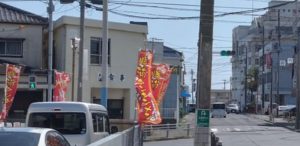
拡大するとこんな感じ、左ののぼりは真横(右方向)に揺れているけど、右ののぼりは私方向に揺れています。
左右で揺れ方が違う。。?また、揺れ方も不規則で、ひっきりなしにのぼりの揺れ方が変わります。
「海風であれば、私の方向に向けてずっと吹き続けるはず。左ののぼりが右に向けて揺れる(海に対して直角方向)って、どういうことだろう??」
「風も止まるまでは行かないけど、何か風が巻いているよう。。強くなったり、弱くなったり。。どうも変だな。。?」
そして、立ち止まる事、数分。。
「そうか、分かったぞ。。」
私は静かな興奮に包まれました。自らの体感で海風を感じ、のぼりの揺れ方を観察していたら、人間本来の直感が作動したのです。この不規則な強い風って、ホテル三日月さんの「ビル風」なんじゃないかと。
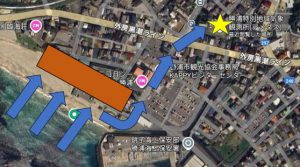
【仮説2】ホテル三日月さんのビル風で、海風が右側に収束してアメダスに向かうケースです。風力を測定した訳ではありませんが、勝浦駅前交差点の勝タンのぼりのバタバタは激しく、私の感覚としてもこちらの方が風が強い気がしました。
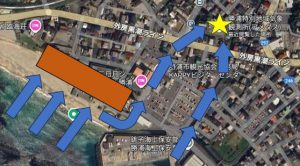
【仮説3】そしてこれが仮説3、墨名川をさかのぼってくる海からの「谷風」そして三日月さんの「ビル風」その二つが複合していることも考えられます。風はまんべんなく海からやってきている訳ですから、片方だけというより、両ルートから来ていると考える方が自然です。
左側ののぼりが、右に揺れた理由も、これなら説明がつきます。
そして、最後の詰めは「データで読み解く勝浦が涼しい理由」項目3の部分で予報官さんが分析されているように、アメダスの南側が崖になっていて、南南西の風が駆け上がりやすいとするなら、まさにアメダスの場所はこんな感じと言えるでしょうか?
(生成AIでイメージ作成)
勝浦のアメダスの場所は、海風が収束し、崖を駆け上がる“海風タイタニック”な場所だった!!と。
あくまでこちらは、気象学の専門家でもない素人である私の「個人の自由な発想」であることをお伝えしておきます。正式な見解は予報官さんの方を参考にしてください。
お伝えしたいのは、「専門家が言っているから」「科学的なデータで証明されているから」では終わらせず、自分で足を運んで確かめる探究心を持つこと。
興味を持って「常識」に疑問を持ったら自分で調べてみる大切さ、そして「真実はこうなんじゃないか!!」と感触として得た体験は格別で、正しいか正しくないかを超えた感動があります。
私のように知的好奇心が旺盛な方には、このような「探求型リトリート」もオススメです(笑)
この日の探求は、まるで大人の自由研究。仮説を立て、現地を歩き、海風を感じる!!そんな時間こそが、私にとっての日々の疲れを癒す最高のリフレッシュであり、今回のリトリートでした!!
こうして自分のリトリートは続いて行きます。
I’ve been so busy lately!!
The cicadas are screaming, the air is thick and heavy, and summer is in full force.
As for me—Kame-Rito Toyoshima—I’m running around every day catching insects, fishing, and even hunting for rhinoceros beetles.
I’m definitely getting tired, but with my regular “personal retreats,” I’m managing pretty well.
Now, about yesterday’s blog entry, “Titanic in the Mountains.”
To be honest, that’s the kind of mindset I live with every day.
People who enjoy the TV show Bura Tamori probably feel the same way.
If you’re someone who loves terrain, natural phenomena, and history, then you’re the kind of person who naturally finds joy in observing, sensing, and discovering the world on your own terms.
One of the people I respect the most, Tamori-san, is someone who has mastered the art of “living through feeling”—observing, sensing, thinking, and savoring life with his whole being.
That aside—on my first proper day off in a while, I suddenly decided:
“I’m going to find out for myself why Katsuura is said to be cool in summer!”
From 2001 to 2008, I actually worked in Katsuura for seven years as a thalassotherapy (marine therapy) therapist.
Recently, people have been saying, “Katsuura is surprisingly cool in summer,” but honestly…
I lived there for seven years, and my memory is: “No, it was pretty hot!!” (lol)
So I decided to check it with my own feet.
Switching on my “explorer mode”—this too is a form of retreat.
Reading the Data: Why Is Katsuura Cool?
Of course, weather experts already have official, data-based explanations.
And yes, the official interpretation is correct. My theory is just a personal one.
But modern people have a bad habit:
When we hear “experts say” or “the data shows,” we stop thinking for ourselves.
We stop asking questions. We stop checking things with our own senses.
I prefer to ask:
“Why does the data say that? What’s behind it?”
I remembered how hot it actually felt back then, and I didn’t want to ignore that intuition.
Exploring things we’re curious about—this is such an important habit.
Sure, we can look up anything instantly on our phones.
But if we stop feeling and stop checking with our own senses, we end up living a life ruled by academics, Google, and AI.
Anyway—off to Katsuura!!
I drove south along Route 297 from Otaki, the U.S. military radio playing hit songs and upbeat English DJ talk.
Great English listening practice, and the perfect soundtrack for a refreshing drive.
And then—
I spotted a sign: “Cake Shop on the Hill.”
Well… it was my day off. (lol)(lol)
I agonized over strawberry shortcake or melon shortcake, and in the end, I chose… both.
Retreat Masters listen to their hearts. (lol)
Temptations along the way aside, I arrived safely in Katsuura! The ocean was so blue!!
But my destination wasn’t the beach—it was the Katsuura AMeDAS weather observation site, which records Katsuura’s official temperatures.
And here was my hypothesis:
Maybe the AMeDAS station is simply located in a breezy spot—
near the sea or in a place where the sea breeze shoots through (“Titanic in the Mountains”-style).
Back in my Katsuura days as a surfer, I went everywhere from Kujukuri to Tateyama based on wave conditions.
And honestly, anywhere along the outer coast:
“If the sea breeze blows, it’s cool.”
That’s what my body remembers.
But when I followed Google Maps to the AMeDAS location, it took me to… a liquor warehouse?
Not right.
So I started asking around.
Even the local Chamber of Commerce staff said, “Is there an AMeDAS around here?”
They didn’t know either.
When I told them I came because “Katsuura is said to be cool lately,”
the woman at the counter laughed and said, “Is it really cool?”
“No!! It’s super hot!!” I answered instantly. (lol)
From there, I walked around in the blazing sun to find the actual place.
Eventually… there it was!!
AMeDAS equipment, right along the small Tonagawa River.
Tonagawa is a very narrow river, with both sides reinforced by concrete—almost like a mini canyon.
A nearby restaurant was even named “Kaikaze” (Sea Breeze).
That made me wonder:
Could this river be a pathway channeling the sea breeze inland?
Walking downstream, I saw the river leads directly to the sea.
The moment the sea breeze touched my cheek—instant cooldown.
“Yep. Sea breeze = Katsuura becomes cool.”
My theory didn’t feel so off.
Hypothesis 1: Sea Breeze “Valley Wind” up the Tonagawa River
A small river can act like a tiny valley.
With concrete embankments on both sides, it might funnel the breeze inward with nothing blocking it.
But I didn’t want to jump to conclusions.
So I walked to the main intersection by Katsuura Station.
Facing south, I could see the ocean on one side and the massive Hotel Mikazuki on the other.
Here, the wind felt even stronger than by the river.
At the AMeDAS corner, the flags of the Katsuura Tantanmen shop were flapping wildly.
Definitely a strong sea breeze.
But then I noticed something odd:
Two flags right next to each other were fluttering in different directions.
That shouldn’t happen with a simple sea breeze.
I watched closely:
The wind strengthened, weakened, shifted direction irregularly.
And then—after a few minutes:
“I got it.”
A quiet thrill ran through me.
This unpredictable wind…
It must be building wind—generated by Hotel Mikazuki.
Hypothesis 2: Sea Breeze + Building Wind from Hotel Mikazuki
The huge hotel structure could be funneling and compressing the breeze, sending a stronger rush of air toward the AMeDAS station.
Hypothesis 3: A Combination
Sea breeze traveling up the Tonagawa “valley,”
plus
building wind generated by Mikazuki’s structure.
That would explain the inconsistent flag movement perfectly.
Finally, according to the meteorologists’ official analysis,
the landform south of the AMeDAS site is a steep slope, making it easier for south-southwest winds to climb upward.
That means:
The AMeDAS site is basically a “Sea Breeze Titanic”—
where multiple streams of cool air converge and rise.
Of course, this is just my personal theory from on-site observation.
For the official explanation, please refer to the meteorologists.
What I really want to say is:
Don’t stop thinking just because “experts say so” or “data proves it.”
Stay curious.
Question the obvious.
Use your own feet and senses.
And when something clicks—“Ah, this might be the truth!”—
that moment is priceless, beyond right or wrong.
For those with a strong intellectual curiosity like me,
I highly recommend this kind of “Exploration Retreat.” (lol)
This day felt like an adult version of summer research projects.
Form a hypothesis, walk the actual site, feel the sea breeze.
This hands-on exploring refreshed me far more than staying home.
And like that, my own retreats continue to evolve.
———————————————————————
【追記】自分のリトリート実践例です。
【リトリート番外編】
【リトリート休養術】